The Monastic Background
The story of monasticism really begins with St Anthony in the Egyptian desert, sometime in the third century AD. Christianity is a missionary religion, but there have always been large numbers of believers who have wanted to get away from earthly temptations, not to mention the endless persecutions suffered before the Edict of Milan, and devote their lives to prayer and to God. Saint Anthony is one of the Desert Fathers, who led hermitic lives in the Egyptian desert. His ascetic lifestyle, and the lives of the thousands who followed his example both during his lifetime and after, laid the foundations for the monastic movement.
Possibly the single most important figure in the early story is St Benedict of Nursia, who founded a monastery in Monte Cassino in 529 in an attempt to flee the moral failings of Rome. He wrote his famous Rule of St Benedict in the 540s, setting out the main precepts for monks wishing to live in a monastic community under the rule of an abbot. His example was being copied far and wide as the Dark Ages wore on that hundreds of monasteries had been founded across Europe by the time Charlemagne ordered the Rule to be distributed throughout these communities as the moral standard by which the monks and nuns within should live their lives.
In Britain, however, there is also a strong influence from the Celtic Saints who swept through the British Isles from Ireland - St Patrick, St Ninian, St Cuthbert, St Illtyd, St David and St Columba are all important forces for monasticism's hold in the country. Monastic foundations at Whithorn, Lindisfarne, Iona, Clonmacnois, Llantwit Major, Caldy Island and St Davids all were founded by these Celtic missionary saints, who learned from each other before founding houses of their own. A cohesive monastic movement it was not, however, as monastic foundations tended to be localised affairs under their own abbot or abbess, inspiring others to strike out on their own and not to blandly imitate.
Irish monasticism was based on a community of people living together under the rule of the abbot or abbess, on land granted for the purpose by the leading local family. As time wore on, the abbot or abbess was chosen from among this ruling family, keeping the strong ties between the secular and the sacred within the community. As the centuries wore on towards the Norman invasion, the Irish way was blended with the Rule of St Benedict into the system of monasticism that flourished throughout not just Britain but, thanks to the missionaries, most of Europe.
Education was always a hugely important function of the monasteries, and foundations such as Lindisfarne, Monkwearmouth-Jarrow and St Davids were all important centres of learning in the early middle ages. Thanks to successive endowments of land from nobles, many monasteries became quite wealthy in this age, with gold plate and jewel-encrusted altarpieces. During the Viking raids from the eighth century, monasteries were singled out and attacked for this precise reason, but following the establishment of the Danelaw and some degree of peace between the marauding Danes and the native Saxons, monasticism continued to flourish as it had been.
The Normans
Monasteries were nothing new, then, when the Normans arrived in 1066. However, the invaders brought with them a special kind of monasticism, the Benedictine Order. Despite being called a 'rule', St Benedict's words had been taken more as a guideline or framework for establishing a monastic community, and it was generally a starting point for monks to live their lives. In 910, Cluny Abbey was established in the Loire, and the Rule of St Benedict was taken to heart as the way to live a monastic life. A rigorous routine of work and prayer ('ora et labora') was established, and caught on so well that other monasteries were established in imitation. These monasteries were called 'priories' to reflect their subordination to the original Abbey.
With the Norman Invasion, the Cluniac way was brought to England, and Lewes Priory was the first monastery to be founded from Cluny in Britain. Others followed, and soon many monasteries were founded throughout the country, the land donated by the Norman magnates and monks brought over from France. The power of Cluny increased, reflected in the size of the abbey, which was the largest church in the Christian world until the new St Peter's Basilica was completed in 1626.
Discord, and A New Way
However, temporal power should not be the aim of any religious house, and the Benedictine Order began to fragment because of this. Many sought a stricter Rule, which is ironic given the Benedictines were originally founded because of this need, and several groups splintered from the Order. Among them were the Premonstratensian Canons, who followed the Rule of St Augustine and founded more autonomous abbeys first in Germany and Austria in the 1120s, before sweeping through central Europe and to Britain, such as Dryburgh and Fearn in Scotland, Egglestone in County Durham and Easby near Richmond, and Talley Abbey in Wales. The Savignac Order traces its origins to 1105 and the Abbey of Savigny, where a congregation of monks gathered around the hermit St Vitalis in an effort to reform the Benedictine Order from within. At first very successful, being exported to Britain largely by the patronage of King Stephen, with the first foundation at Furness in Cumbria, by 1147 the Order had hit financial difficulties and merged with the Cistercians (more shortly).
In 1131 the first (and only) wholly British monastic Order was created by St Gilbert, the Gilbertine Order. Catering for both canons (men) and nuns (women), the Order soon outgrew St Gilbert's church at Sempringham, Lincolnshire, as his popularity spread. Joint houses for men and women had existed in pre-Norman Britain, but the Gilbertine Order was the only one to cater for this in the modern monastic context, perhaps accounting for this popularity. Gilbert, unable to cope with this explosion of popularity, asked to merge with the Cistercians also, but due to the mixed nature of his monasteries was refused.
The Carmelite Order appears in 1226 following the rule of St Albert, which is a sort of pared-down version of that of St Benedict. The White Friars, they founded monasteries in towns and cities, such as Chester, Coventry, Nottingham and Gloucester, and were a part of the Mendicant movement of monasticism that sought to bring religion to the people and work within the community rather than to shun society in favour of cloistered asceticism.
Other mendicant Orders to appear in the early thirteenth century were the Franciscans (Grey Friars, founded 1206), Dominicans (Black Friars, founded around 1216), and the Augustinians (founded 1244, without colour). All of these orders had foundations in Britain, centred around the rapidly-growing towns and cities where often more than one church could be found catering to the spiritual needs of the populace.
However, the most successful of the Benedictine offshoots - indeed, a true medieval success story - was the Cistercian Order. Founded in 1098 at Citeaux Abbey, near Dijon, it was with the foundation of Clairvaux Abbey in 1115 by a monk from Citeaux, St Bernard of Clairvaux, that the principle of the Order was established. St Bernard insisted on a strict following of the Rule of St Benedict, and ensured the Rule was enforced throughout the monastery. The practice of establishing 'daughter houses' from the 'mother house' (all Cistercian monasteries were dedicated to St Mary the Virgin), allowed for their rapid spread throughout Europe. Unlike early Celtic traditions of self-sufficiency, Cistercian monasteries had strong ties to each other, and a General Chapter was called annually at the mother house in Citeaux, where all Cistercian abbots attended. A modern-day AGM, if you will.
I have discussed the Cistercian methods previously as comparable to modern business, and the analogy is clear from the economy of the Order. While still reliant on donations of land from the nobility, Cistercians would accept any land, be it arable or scrub, and set to work terraforming what they were given in order to turn a profit. Following an age of lavishness and near-luxury, the Cistercians emphasized ascetic living and a purity of space, which is really exactly what the spirit of the age demanded. The 'back to basics' way proved very popular, and people flocked to join the Order. This popularity led more and more nobles to endow Cistercian monasteries with land, which allowed the Order to spread throughout Europe. The Cistercians arrived in Britain in 1128 at Waverley Abbey in Surrey, and in just over thirty years, Waverley spawned five daughters of its own, which in turn had also gone on to create more daughters. In Wales, the first Cistercian monastery was Tintern, founded from L'Aumone in 1131, and Rievaulx Abbey was founded a year later in North Yorkshire as a staging-ground to launch the Cistercian Invasion of Scotland. This took place in 1136 at Melrose Abbey, with ten more abbeys founded throughout Scotland tracing their origins to Rievaulx. Ireland, with a strong religious monastic tradition of its own, saw the first Cistercians in 1142 at Mellifont, Co. Louth.
It's a wonder the Cistercian monks found any time for prayer at all, given all this movement. The Cistercian way around this was ingenious, really - to ensure the monks could give sufficient time to prayer, they recruited lay-brothers to do the work demanded by the Rule of St Benedict for them. Basically uneducated locals, lay-brothers would tend the fields and look after the repairs and other day-to-day mundanity, while the choir monks would copy texts, both groups coming together to attend the eight services in the church throughout the day. Only, it wasn't quite a coming together, as the church was a divided place with the lay-brothers at one end and the choir monks at the other. Cistercian popularity led to enormous landholding power, and so a system of granges was developed, basically manor farms where lay-brothers could work the land under the oversight of a steward. The real economic power-base for the monasteries lay in these granges, specifically the sheep farms that produced the wool Cistercians became famous for dealing in. Before the discovery of America, and thus the discovery of cotton, all clothing was made of wool (unless you were rich enough to afford silk), and supply for wool was enormous. Cistercian wool from granges across Britain was sold to Florence and Venice, as well as Belgium and France. Because of this, abbots found themselves with actual economic, temporal power, only a couple of centuries after the Order was first founded in an attempt to escape from this development within the Benedictine Order.
The Cistercians continued their missionary activities throughout the twelfth century and into the thirteenth, the Golden Age of monasticism. As new monastic foundations slowed down in the middle of the thirteenth century, the Cistercians turned their attention to consolidating their position by rebuilding their churches and monastic buildings in stone. These ventures began in quite a simple and restrained manner, but as time wore on the buildings became increasingly dazzling in terms of their decoration, and ever more daring in terms of what they accomplished. Gothic architecture became the order of the day, and the flamboyance of English Gothic in particular led to the development of the Perpendicular style of unimagined decadence of design. Only the Black Death put a stop to that.
In fact, the Black Death put a stop to most monastic activity. Numbers were down, both in choir monks and in lay brothers, so granges were sold off (often to the lay brothers who farmed them), and the centre of interest was contracted around the abbey. Many houses found themselves in huge debt in the aftermath of the pestilence, as the abbots had been speculating on the wool trade to gain the money required to build in ever more lavish style. This proved to be only a temporary setback, however, as many abbeys recovered into the fifteenth century, albeit nowhere near the heyday of the twelfth and thirteenth centuries.
Emerging Nationalism
However, another problem arose in the fifteenth century, in the years following the Hundred Years War. Most of the monastic foundations in Britain owed their provenance to France, with whom England had just been at war. While Cistercian abbeys were largely autonomous, attending the General Chapter in France but otherwise regarded as domestic establishments, the Cluniac Priories were distinctly French, paying a stipend to Cluny every year. As such, they were known as 'alien' priories. King John had first attacked the alien priories, demanding a payment of his own, or 'apport', which in a way is a fair decision. The Church had become one of the biggest landowners in England, and not only charged rents on lands it did not farm directly, but claimed a tithe to any person living on Church lands - a tenth of the rent the landlord collected. The Pope furthermore demanded the Church levy a tax of the first year's income on any new landowner. This money, in the case of the Cluniac priories, often found its way across the Channel. Edward I re-implemented the apport while at war in Gascony, and Edward II continued the policy (though perhaps more as a form of taxation than due to any real Nationalism). Edward III initially fostered good terms with the alien priories, cancelling the apport, until the Hundred Years War broke out in 1337. In addition to the apport, land was also lost by the priories during the conflict - the worst blow coming in 1378 when the monks were expelled from the country.
Some priories were placed under the control of domestic abbeys, but many others petitioned to be naturalized. Wenlock Priory in Shropshire petitioned Richard II in 1395 and was granted Englishness for the sum of £400 (nearly £8m in 2011) and the condition that prayers were said for his deceased wife Anne of Bohemia annually on the anniversary of her death.
The Political Aspect
So much for monasticism's religious history. However, this blog purports to be about the Suppression of the Monasteries, so now you know all about the beginnings of these great buildings, let's move on.
The Wars of the Roses are really where it all begins. A subject too fascinating to discuss as merely a part of another blog, I'll suffice for now to say that it was an on-and-off civil war that lasted thirty years between the ruling nobles of the country. The victor of course was Henry VII, descendant of the duke of Lancaster who founded the Tudor dynasty and married Elizabeth of York, the daughter of Edward IV, to cement his claim to the throne. Henry is famous also for his calculating plans for his rule, including planning the futures for his children. His eldest son, Arthur, was married to the Spanish princess Catherine of Aragon, the youngest daughter of Ferdinand and Isabella (the ones who joined together the kingdoms of Aragon and Castile respectively to create the kingdom of Spain, and who also financed Christopher Columbus in his trek to America). His second son Henry was destined to be Archbishop of Canterbury, if not a Cardinal or more. His daughter Margaret was married to the King of Scotland, and his youngest daughter was married to the King of France.
All went well until, five months after the marriage, Prince Arthur died, in somewhat mysterious circumstances. However, the mystery only arises because of what happened later. After some manoeuvering on Henry's part, Catherine was married to the second son, now Prince Henry, and all was well in the kingdom. The marriage was specifically allowed by a Papal Bull issued by Julius II, even after Catherine testified it had never been consummated, which allowed in canon law for Henry to take his brother's place.
Henry succeeded his father as Henry VIII in 1509, aged 18 and with all the confidence of a new King Arthur. Catherine was immediately pressed into service as the Royal Baby Machine, and over the course of her marriage to Henry she found herself pregnant six times, though only one child made it to adulthood, Mary. There is barely a year between some of these births, the poor woman. By the time of her sixth pregnancy, which ended with a daughter who survived six days, Catherine was in her late 30s and considered too old to continue in the function of Queen.
The Great Matter
Anne Boleyn, however, wasn't. The daughter of the Earl of Hampshire and granddaughter of the Duke of Norfolk, Anne was Catherine's lady-in-waiting. Due to certain historical fictions, it seems we all now know her elder sister Mary Boleyn was a previous mistress to the King (in fact she bore Henry two children, neither of whom was officially recognized by him), and so it is logical that Anne would have seen what had happened to mistresses once they were no longer flavour of the month. There has been much sexing-up of the situation of Anne Boleyn, portrayed as a power-hungry succubus who had her eyes set on the throne and Catherine's downfall almost as soon as she arrived at court from her years spent in training on the Continent. Also, much has been made of Henry's break with Rome simply to get Anne into bed. But I do believe this chronically-simplistic view of things fails to take account of some very important facts.
Anne undoubtedly attracted Henry, possibly in ways Catherine never did. For example, Henry is known to have liked his girls to have small breasts and feet, which Anne had (by all accounts). Anne brought with her from the Continent some very interesting ideas, however, and I feel that it is possibly these that ignited a spark in Henry almost as much as those other bits. She challenged him, and she is believed to have actually stood up to him in philosophical discourse. She also stood up to him as regards moving up to the bedroom - she refused to have sex with the King until she was his Queen. Bold stuff, I'm sure you'll agree.
Henry was trained to be Archbishop of Canterbury, remember. A startling part of this fact is that he corresponded with the religious philosopher Erasmus when he was still a child, but in such a way as to appear as equals rather than master-and-pupil. Henry, being a prince of the realm and destined for the church no less, had the very best education his father the King could provide, perhaps even more so than his elder brother Arthur - a future Archbishop would need more academic education than a future King. Even after his brother's death, Henry's education was impeccable. When Martin Luther nailed his list of ninety-five theses to the church door in Wittenberg, Henry wrote a very astute letter of condemnation that so impressed the Pope that Henry was granted the title Defender of the Faith, something that the monarch still holds to this day. My point in all this, anyway, is that Henry knew his theology, and he knew it as an expert.
There is also the reason why I prefaced this with going back to the Wars of the Roses. Henry knew that the anarchy of civil war would return unless he could father a strong son to succeed him, as the debacle of Henry VI's reign had shown. Perhaps mindful of the relatively weak claim to the throne his dynasty had, his overriding concern was the continuation of the Tudor line through a male heir, and Catherine was now judged to be too old to provide him with one. I believe this concern was the biggest of Henry's reign, and if not Anne, then there would have been a marriage sought to some other woman who could perhaps provide the son Henry so desperately needed.
So Henry resolved to divorce Catherine and marry Anne.
This is actually possible in canon law, it is not the case that Henry stopped being a Catholic in order to divorce his wife. Far from it - Henry in fact never really saw himself as anything other than a Catholic. It isn't so much a divorce, however, as an annulment - the marriage was illegal ab initio, and so is considered to have never taken place. Henry knew canon law, of course, and sent his secretary to Pope Clement VII in 1527 to petition for the earlier Papal Bull issued by Julius II that allowed his marriage in the first place to be declared null and void. The idea was that Catherine had lied about the marriage never being consummated, and so the Papal Bull had been issued under false pretenses. A nice piece of stage-management, that: Henry didn't want to be so crass as to say Julius was outright wrong to allow the marriage, merely that Catherine was so wily as to hoodwink even the Pope.
However, in one of history's great coincidences, Clement VII proved to be incapable of providing an answer, as Rome was under siege by Charles I of Spain: Catherine's nephew. While Clement VII had initially managed to escape to the Castel Sant'Angelo, he was still Charles' prisoner to a degree. When Cardinal Wolsey called a full ecclesiastical court with a Papal Legate present, it soon became clear that the Pope would not grant the divorce. Wolsey began to plot with the Pope to have Anne removed from England, but this was discovered and the Cardinal was due to be tried for treason but died on the way to London.
Henry's entire case for annulment rested on a passage in Leviticus (20:21), which states "And if a man shall take his brother's wife, it is an unclean thing: he has uncovered his brother's nakedness; they shall be childless". Despite the fact that his daughter Mary was in her mid-teens at this point, Henry clung to the passage as vindication. Catherine had testified that she and Arthur had never had sex, which Henry claimed to be a lie. He managed to procure "witnesses" to the fact that, once they were housed in Ludlow Castle after their marriage, Arthur was heard to call for a drink one morning, claiming marriage to be "thirsty work". This and other such ribald 'lads' talk' overheard by the guardsmen was used as proof to denounce Catherine as a liar.
I must admit, it does seem a bit strange. Catherine was on the cusp of turning 16 when she married Arthur, and he was about six months younger. They were very much of an age, by medieval standards, for procreation. Catherine claimed that illness kept them apart from the moment they reached Ludlow, and by the time she had recovered, Arthur was dead.
The back-and-forth between Rome and England began to tire Henry, who began to put the wheels in motion to progress the situation.
Henry installed Thomas Cranmer, the Boleyn family chaplain, as Archbishop of Canterbury in 1533, managing to manipulate Clement VII into approving Cranmer in the post, and shortly afterwards married Anne Boleyn. In a ceremony at Dunstable Priory, Cranmer confirmed the validity of the King's marriage to Anne, and decreed that to Catherine was null and void because she had previously been married to the King's dead brother. Catherine found herself now under a strange form of house arrest at Kimbolton Castle in Cambridgeshire, where she was permitted visitors but refused to see her daughter, or in fact to leave. She died in January 1536, with rumours that Henry or Anne (or both) had poisoned her. On the day of her death, Anne miscarried a son.
The cost
So Henry had married Anne, and had effectively granted himself annulment of his marriage to Catherine. Firstly, Clement VII excommunicated Henry and Cranmer for going against his prohibition of the marriage. In turn, Henry passed the Act of First Fruit and Tenths. As mentioned earlier, the Church claimed a tenth of all rents and the first year's income on a new landowner's profits from his land. Well, Henry stopped that in 1534, diverting the money into his own treasury. Anne, perhaps on a suggestion of the Bishop of Salisbury, suggested the first-fruit income (valued at £14,000 in 1534, the equivalent of £7.7m in 2011) be used instead on charitable works for the poor, and it is still in effect today, known as Queen Anne's Bounty.
Next on the legislative table was the Ecclesiastical Licences Act, known also as the Peter's Pence Act, forbade any other form of payment by an English landowner to Rome. Peter's Pence specifically is the annual tribute collected on 1 August since 1031, although it was often withheld during the fourteenth century against "obstinate" Popes. Unlike with the tithes, the payment ceased altogether, the Act specifically stating it would not be collected by anyone. It also allowed any dispensations formerly made by the Pope to now be made by the Archbishop of Canterbury. The Preamble of the Act makes the first reference to the King being the absolute head of the realm and subject to no-one, temporally or spiritually. Interesting stuff, which paved the way for part three in this legal triptych.
The Act of Supremacy passed in 1534 made Henry the supreme head of the Church in England. There is a very crucial preposition here. Henry is head of the Church in England, not of England. The Church of England comes later. Henry kept traditional Catholic practices and condemned as many Protestant heretics as he did Catholic ones. All the Act of Supremacy does is essentially confer the privileges of the Pope upon Henry within England (although no second Schism occurs because Henry is very careful not to actually claim the title of Pope for himself). Thomas Cranmer is famous for feeling the Reformation under Henry did not go far enough, and it wasn't until Edward VI that the Church of England began to supplant Catholicism properly.
So what about the monasteries?
For a long time, monastic life had been moving far away from the ideals of the eleventh and twelfth centuries. A career in the Church had been a viable option for centuries - I've already mentioned how it was the preferred choice for second-born sons, Henry being a case in point. If the fact that monasticism was seen as a "career" and not a "calling" doesn't set alarm bells ringing, then the increasingly materialistic life of ecclesiastic foundations should. Abbeys and Priories across the entire nation had been amassing a lot of land, from which they derived a lot of wealth, which was initially ploughed into the monastic community, specifically into the beatification of the House. As a product of their increased landholdings, abbots and priors became astute businessmen, and began to gave themselves licence to a more worldly existence, if you will.
Initially, the monastic ideal was that all men are equal before God. This quickly was proven to be a lie when one monk would be elected the abbot or prior, elevating him to a higher status than the other monks. The abbot would, at first, sleep in the dormitory with his monks, but as the centuries marched on the abbot granted himself separate quarters. Of course, today this seems highly suspect, and we might point to it as immediate evidence of monastic ideals breaking down, but in the medieval context appearances were important. Particularly important in the communication of status in a highly stratified society. As massive landowners, monasteries (and in particular, the abbot or prior) had a very important position in this society and so a very important image to project. So, while on the one hand the self-aggrandizement of abbots and priors appears to be evidence of a secularization of the monasteries and a breakdown in their purpose, on the other it is merely a response to the developments of the world outside the precinct.
Further divisions occurred when lay-brothers were recruited, the choir monks quickly delegating all the menial tasks, as I have previously discussed. But even the recruitment of lay-brothers can say much for the continuing spirituality of monasteries. Choir monks had more time to devote to the holy work, the 'labora', of the Rule of St Benedict, so it could perhaps be said that an increase of spirituality was a result of this.
And yet, this is not the picture that emerges in the official record. Wolsey had made some effort earlier in the century to curb the abuses of the Church, which had crept in over the years of religious monopoly. It is well known that the Church charged for pardons, and also the practice of land-grabbing secured by 'mortmain', but there are many other infractions committed in the name of God. In a feudal society, men held land of the King in exchange for military service, and after his death his lands reverted to the King - when men left their lands to the Church, the religious institution would never die, and so the lands would never revert to the King (I'm sure you all know the scenes in the episode The Archbishop of The Black Adder?) This one in particular had stymied many a monarch, and Edward I had tried to make some effort to stop this in the 1270s, to say nothing of Magna Carta's efforts.
Manoeuverings
It is unclear when exactly Henry turned his attentions to the monasteries. Suspicions abound as to whether Anne Boleyn turned his attention to the Houses of the Lord, of course. The fact of the matter is, however, that a series of expensive foreign wars in the 1520s on the Continent had left Henry's treasury quite severely depleted. In fact, his entire reign could almost be said to have been an exercise in depleting the coffers his father had been so careful in building. But involvement in the Italian Wars, and also in his continual one-upmanship with Francis I of France, made him desirous of money. Which is something the monasteries possessed in abundance by this time. The King's Chief Minister Thomas Cromwell had been working to diminish the monastic income, on the grounds that it was inappropriately gained. Mortmain in particular was seen as an illegal misappropriation of the King's funds, anyway.
In January 1535, things began in earnest when Cromwell dispatched his men to survey the monastic holdings throughout the realm. This valuation, the Valor Ecclesiasticus, assessed the income of the religious houses thoughout England and Wales, and the approximate value of all their lands and possessions. As a fringe benefit, it also passed comment on the state of affairs in each. There are problems with this survey, of course, as certain assumptions can be made that cast its validity into doubt. Thomas Cromwell has already been shown to be anti-monastic, and could well have instructed his men to "find" evidence of the moral lapse in the abbeys and priories. Or perhaps the commissioners would have thought by making such "discoveries" they were pleasing Cromwell (and, by extension, the King), for their own advancement at court. The Valor Ecclesiasticus, while being of infinite interest in studying this topic, must be treated with a large degree of caution.
Assuming, then, that Henry and Cromwell treated the Valor Ecclesiasticus as nothing more than fabricated evidence to justify their foregone conclusion that the monasteries would be closed, why on earth would one be interested in it? Well, ignoring the accounts of the various iniquities reported to take place at the monasteries, it is entirely possible that the valuations were more accurate. For example, Westminster Abbey is deemed to be the wealthiest monastery in England, followed by Bury St Edmunds and Glastonbury. These top three houses are known to have been extremely wealthy in their day - Westminster being the "royal monastery", and both Bury St Edmunds and Glastonbury were exceptionally wealthy because of the pilgrim 'trade'.
Some of the reports have abbeys where the monks perhaps have separate sleeping quarters (rather than the communal dormitory), their abbot living in something akin to a hall-house rather than the more simplistic life. These kinds of developments are perhaps a natural progression of the increasingly materialistic middle-ages, and so when the monastery is said to have had such "lapses", its valuation can perhaps be taken with a greater degree of certainty. Other monasteries have quite perverse goings-on, such as Haughmond Abbey, where the monks appear to have been given over to paedophilia and fornication, drunkenness and idleness, among other accusations. This of course can be true, but it is sometimes so outrageous that it perhaps needs to be taken with more than a pinch of salt.
The Valor Ecclesiasticus also set about disproving the power of relics, upon which the pilgrim business relied, and all of which smacked far too much of popery for the nascent Anglican country. Hailes Abbey in Gloucestershire was well-known for its possession of, among others, a phial of Holy Blood. Cromwell's commissioners 'proved' that this 'relic' was in fact a fake, securing the abbot's own admission. However, there is also the peculiar story from Durham, where the commissioners opened St Cuthbert's tomb to disprove his sainthood, but found the body to be perfectly preserved - and thus, proving the very fact they had hoped to expose as fraud.
Personally, I think that there are many instances within the pages of the Valor Ecclesiasticus where the situation is either exaggerated or plain fabricated in order to paint a picture of a degraded way of life, and justify the coming action from the King.
The Beginning of the End
Either way, the reports of the commissioners formed the basis for the Suppression of Religious Houses Act 1535. By the clauses of this Act, any religious house that is worth less than £200 was to be dissolved, its property reverting to the King in perpetuity. The law came into force in March 1536, with hundreds of monasteries closing down. Interestingly, it was possible for monasteries to buy their way out of this, and continue on past 1536, if they paid the difference between their assessed income and the £200 figure needed to continue operating. More than 60 monasteries went down this route, but they weren't to know it was but a temporary reprieve.
It is difficult to discern precisely how much money Henry gained from this first round of closures, but it certainly made him very rich. Figures like £1.5million have been mentioned (this is, staggeringly, equivalent to about £22,290,000,000 in 2011-terms) but so much of monastic income was tied up in land and rents, as well as what I suppose you could call their 'mineral wealth', ie the money gained from selling off the lead, the gold plate, the glass, etc. More reasonable estimates have been made around £150,000 (nearly £82m).
It wasn't as bad as it all sounds, though. When we think of the Dissolution of the Monasteries today, if we think of it at all, there is perhaps a tendency to concentrate on the bare facts - Henry VIII closed the monasteries, seized their assets, and began the process of Anglicanisation of the country. It sounds like Henry really was the tyrant history seems intent on making him. The monks were pensioned off, however, with many given homes in the community and jobs as parish priests. If there was a monastery within the area still left open (over 200 of them were left alone by the 1535 Act), the monks were allowed to go there and continue a religious life. Officially, of course, Henry was doing the long-overdue job of cleaning up the religious life of his kingdom.
The Pilgrimage of Grace
It would be wrong to assume, of course, that the monks just accepted all of this. While it is true that some were quite happy with their pensions, and some possibly welcomed the possibility of returning to the material world, undoubtedly many were upset with the course of events. We're talking about men who lived in an age of spirituality, no matter how degraded that may have become since the glory days of the thirteenth century. It was still a widely held belief that God was real and heaven existed as a real place, and people still lived in abject terror of the thought of going to hell once they died. Men who had dedicated themselves to a life of prayer and seclusion were having that life turned upside-down, and some of them weren't happy about it.
In October 1536, the holy men of Lincolnshire had had enough. To an extent, the revolt was brought about by the king's commissioners, who went about the business of stripping those monasteries that had been closed with an almost lewd, brute vigour. The popular uprising in Lincolnshire brought over 40,000 people to Lincoln Cathedral, where they demanded to be allowed to continue to worship as Catholics, and that the property of the cathedral be left alone. Henry's response was predictably intolerant. He sent the duke of Suffolk to disperse the rebels, and the ringleaders were executed for treason within days. However, this popular protest paved the way for the much larger event of late 1536, the Pilgrimage of Grace.
The London barrister Robert Aske presented a series of grievances the people of Yorkshire had with the king's actions, notably what were seen by conservative northerners as religious abuses. Furthermore, by this time, Anne Boleyn had been executed and Henry had since married Jane Seymour. The people had been unimpressed at the king's treatment of Catherine, but were even more disgusted at the way he was carrying on, and the execution of Anne served to undermine a lot of the early ideals of the Act of Supremacy.
Robert Aske and his followers marched on York, expelled the king's tenants from the abbey and resumed Catholic services, returning the monks and nuns to their former places. Popular support proved to be so great that the king opened negotiations with the rebels, and promised to halt any further monastic suppression until he had reconvened parliament. Round One to the rebels.
The following February, all hell broke loose. The leaders of the rising were captured and executed for treason, including six abbots of the northern abbeys, and numerous monks, parish priests, and noblemen. 216 in total, and with the executions of the leaders, the revolts soon died out. However, there are elements of success that cannot be overlooked here, as well.
The Reformation?
As you probably know, the commonly-accepted beginning of Protestantism and the Reformation of the Church began in 1517 when Martin Luther nailed his list to the church door in Wittenberg. Martin Luther drew attention to the many abuses of ecclesiastical power in evidence at the time, and his views gained considerable support, crucially from the nobility who sheltered him from the Pope's ire. While Lutheran doctrine grew across the Holy Roman Empire, many other reformers also took up the cause with their own thoughts, notably Huldrych Zwingli in Switzerland. Zwingli in turn can be seen to have inspired that great French reformer John Calvin. Continental Reformation was sweeping like wildfire throughout the formerly Catholic nations of Europe, and its ideologies were often extreme.
The big issue was the mysticism of the mass. Catholicism holds that, during the mass, the communion wafer and wine are transubstantiated through the religious power of the officiating priest into literally the body and blood of Christ. Through partaking of this communion, a sacramental union is formed between the worshipper and Christ, that can only be achieved through the ordained power of the priest. Believers can, consequently, only enter heaven as a saved soul through having partaken of communion while on Earth. That priests often charged for this formed the brunt of Luther's attack.
But it also began people thinking about the sacrament. Did the priest really have the ability to transform bread into the body of Christ? Luther didn't think so, neither did Zwingli. For the Protestant reformers, the idea became that the bread and the wine are symbolic of Jesus' presence, but not his actual body or blood. Zwingli in particular pointed to the line where Jesus performs the first sacrament, saying "Do this in remembrance of me" - the sacrament of the mass becomes a memorial, where the presence of Christ is embodied through the communion but the wafer remains a wafer, a memorial of Christ's sacrifice.
Centuries of religious practice, however, were difficult to undo. True, many thinkers tended to agree with the reformers, and Calvin's Geneva became a haven for like-minded individuals who were persecuted in their native land. But in the main, people were comfortable with what they'd been doing since time immemorial, and the thought of change was upsetting. When Henry began his reform of the Church in England, therefore, he was careful not to ruffle more feathers than absolutely necessary where doctrine was concerned.
The Ten Articles of 1536 were the first step in producing a reformed doctrine in England, but they did not follow the more 'established reforms' of the Continent. Four of the seven sacraments were removed, however the transubstantiation of the Eucharist was kept, making early Anglicanism more Catholic than Protestant. Similarly, in 1538 a conference was held with Anglican Bishops and German theologians over the correct course to take, but still transubstantiation was kept, as well as clerical celibacy and private mass, some of the more roundly-criticised abuses of Luther's Augsburg Confession. Archbishop Thomas Cranmer, however, had wanted to bring a more Lutheran approach to the nascent Anglican Church. The Six Articles of 1538 hold many similarities with Catholic doctrine, showing that, while Henry broke with the Pope, he did not break with Catholicism itself.
The End of Monasticism
While he may not have broken with Catholicism itself, he nevertheless continued to close monasteries. In 1537, the abbot of Furness Abbey offered to voluntarily surrender the monastery to mitigate his part in the Pilgrimage of Grace, and following this, voluntary surrenders were accepted by Thomas Cromwell across the country. From 1538, attention was turned to the other religious houses in England - while the secluded monasteries that dotted the countryside were the first casualties, the urban friaries had been left alone. However, as the fifteenth century had marched on, observant friars had declined to the point where, in the 1520s and 1530s, many friary buildings were under-manned and almost derelict. Ignoring the fact that friars performed a valuable service to the community, notably education and important social care roles, friaries were forced to surrender throughout 1538, wiping out the orders in Britain within the year.
In 1535 the Suppression of Religious Houses Act had dissolved any religious house whose total annual income was less than £200, but that still left over 550 religious houses open and functioning. In 1539, a Second Act of Dissolution was passed to close down this remainder. All religious houses were legally the property of the king and his heirs, to dispose of how they pleased. The larger houses that had initially escaped dissolution were hereby closed, culminating in Waltham Abbey, Essex, which finally surrendered on 23 March 1540.
The new era
However, this isn't to say that there was a day, or even a few hours, where there was no religion in England. I did used to think it possible, as all of the history books seem to narrate the course of events being that Henry first dissolved all the monasteries, then set up a new system of cathedrals and bishoprics. The two processes actually overlapped. Eight of the former monastic cathedrals were reinstated as cathedrals of the new Anglican Church, and six new cathedrals were formed out of former monastic churches. This process took some time, with such important sites as Canterbury not being conferred as cathedrals until 1541.
By and large, however, monastic property was sold off to increase revenue for the Crown. Almost as soon as the suppression had began, nobles were petitioning the king to buy former monastic land, and throughout the entire process, Henry continued to accept offers of purchase rather than go through the more protracted auction route. Many former monastic houses were converted into palatial homes for the rich, such as Lacock Abbey in Wiltshire, and Neath Abbey in Glamorgan. The fact that monastic buildings had been undergoing increasing domestication over the fifteenth century made this process relatively easy. Some churches were bought by their communities, Binham Priory in Norfolk and Bolton Abbey in Yorkshire are two examples that continue to this day with part of the fabric still being used for religious services.
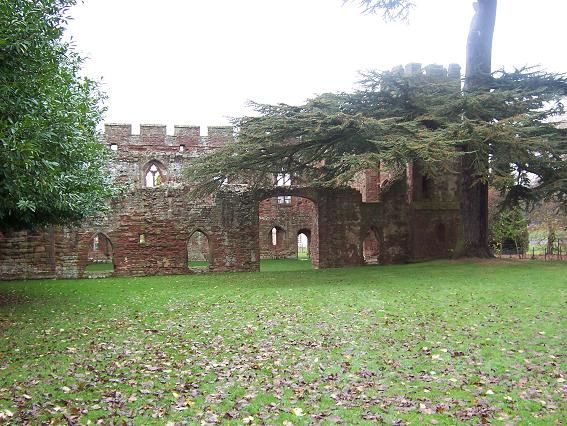
But in the main, the once-magnificent abbey buildings crumbled into ruin as their stone was robbed-out for other building projects. Valle Crucis Abbey in Denbighshire became a dairy farm, Tintern Abbey in Gwent became an ironworks.
It has been suggested that the dissolution of the monasteries adversely affected the development of England. One example was the discovery of a blast furnace at Rievaulx for smelting iron, which would appear to have been on a par with early industrial processes of the eighteenth century. Did the dissolution put back the industrial revolution by two centuries? Material wealth aside, monasteries were also great repositories of learning, and a lot of the knowledge was lost when their scriptoria were raided and trashed. Travel around the country could often be dangerous and expensive, but monasteries could provide safe havens of hospitality for travelers.
The educational function of friaries was replaced by the grammar schools, and care for the poor and sick reverted to parish councils and the later workhouses. Henry VIII single-handedly closed an entire chapter of English history with the dissolution, and initiated perhaps the biggest reapportionment of land since the Norman Conquest nearly five centuries earlier. The legacy of this can be seen today in the vast, skeletal remains of buildings across the landscape.